Sunday, May 1, 2016

Maratón de Santiago: The shirt, the athletes, the dogs, and the metro

The other week (ok, I'm about a month late in posting) was the Chilean sporting festival of the year -- the Santiago Marathon--, just two weeks before the other major international sporting festival known as the Boston Marathon.  

I ran the 42(.2) km, completing the course in a not-my-fastest-not-my-slowest time of 3:37.  I realized this was my first marathon since 2011, apart from the marathon in the Ironman, and gauging my fitness was not easy.  I trained hard for a (10 minute) PR, but several weeks before the race there were hints that might not be realistic.  I scaled back my goals, trying to match-not-beat my best time of 3:30. This seemed somewhat feasible, but only lasted for about half of the  race.  Then the long sustained gradual perpetual never-ending climb between miles 13-20 slowed me to the pace I probably should've started with.  Finally, the last few miles of the race are a glorious slight downhill to downtown, finishing where we began -- the main avenue in front of the government building.

That's the race report (check out the half-marathon report from 2012 for posterity sake!).  But I'm just one of 28000 runners, and there's a lot more than my story that makes this event special/unique/comical/recommended.  Here are the other parts of the bigger story.


1. 28000 runners downtown, most of them wearing the iconic shirt for that year.

Marathon in English is translated to maratón in Spanish, but the usage is not identical.  A running* race called a marathon in the US more likely than not signifies 26.2 miles (*yes, I did a ski marathon that had 25k and 50k options).  A maratón in Chile means running a distance that is longer than a "corrida" (more literally, a "run"), probably more than 5-ish km.  In other words, the term encompasses all of the runners of the Maratón de Santiago, regardless of 10k, 21k, or 42k distance.  And with that, the total participation on Sunday morning in downtown Santiago reaches awesomely high numbers of runners taking the streets.

The race shirt symbolically unifies us. Several weeks before the race each year, the organizers reveal the color of the shirt, and plenty of hype surrounds. Race shirts spark plenty of superstitions among US runners especially, and some think the shirt shouldn't/can't be worn until earned by crossing the finish line.  Chileans, on the other hand, traditionally wear the shirt in the race, building a sense of belonging, and great group photos.  For years to come, we will proudly wear our shirts while training in the Santiago streets, and our feat will be easily identified by our fellow runners.


2. The "real athletes"

Something I value about marathons is the experience of running the same course on the same day as the elite runners, often invited from far away countries by the organizers.  Unfortunately I hardly catch a glimpse of them, but not many sports allow amateurs to "compete" with the pros.  This year, we did catch a glimpse as I arrived at the race with a friend, a couple of hours before the gun went off.  I was feeling like a groupie and staring at the darkened windows of the official athlete bus, only to be shunned by the organizer directing traffic: "you can't pass, this is for athletes." My friend's mom replied, "I'm dropping off two athletes."  His response: "I mean it's only for the real athletes."  Laughing, we took the long way around, knowing that when the gun went off we fake athletes would be following in their fast foot steps.

3. The dog situation

Race photos surfaced in recent years showing street dogs mingling with the runners during the race, and revealing a pervasive dog presence downtown.  While it may be an insurmountable challenge to keep dogs from entering the streets of the race one Sunday morning each year, this year the race organizers and animal rights groups teamed up to address the issue.
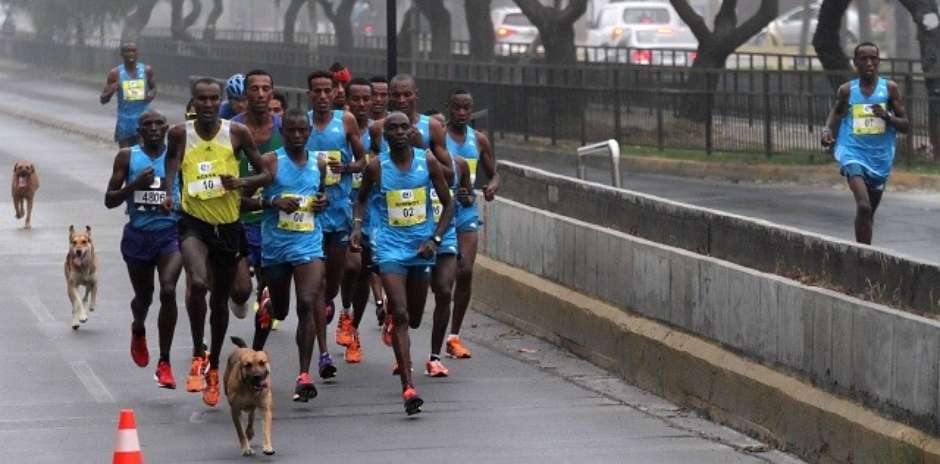
From the other year, "the dogs steal the show" says the news headline.
Early Sunday morning, dogs were rounded up and treated to food, water, shelter, toys, and love during the race.  An adoption campaign looked for permanent homes throughout the day, and some number were spayed/neutered. The outcome, I actually don't know. But the awareness and good intentions, and a bit of creativity, were there.


4. Riding a metro, sweaty and with a medal.

On a normal day, I avoid riding public transportation when I'm sweaty and/or trains and buses are crowded.  Marathon Sunday breaks the norm.  The subway fills with runners going to and from the race, with race numbers visible early in the morning, and medals proudly displayed a few hours later.  The city agreed to open the subway 1 hour early on race day, still not quite early enough for the 42k start, but a valued gesture for the 21k and 10k runners. I remember from previous years as runners piled in at each stop, filling the car with the race-day shirts and plenty of pre-race nerves.

Following our once per year, extended morning tour of downtown Santiago, I caught the metro home.  Now the runners filtered out at each stop.  When we reached my metro station towards the end of the line, the city and the metro were pretty much back to the state of a normal Sunday-afternoon.


Wednesday, March 23, 2016

Rollin' on my rest days

A perk, in my opinion, of my job is that once per month I work 80 hours in 8 days at the observatory, and I earn 6 days of "descanso" (rest days). It's a double perk really, because (1) I value the hands-on, focused observing experience for my job, and (2) I'm learning how to utilize "free time" in a country/continent full of natural beauty to explore.

Ask yourself a question, wherever you are: what is fun to you?  For some 6 days each month, I'm going to be seeking my own answer to this question. (Admittedly, the purpose of rest days is to rest, because shifts can be long and tiring, at strange hours. Rest days prepare us to return to work rejuvenated. So, I'll take rest to mean: rest from work. After sleeping an adequate amount.)

I had a few clues of where and how to find my fun, and they involved my bike, mountains, and being outdoors.  For some time, the idea of bike-packing ("cicloturismo") has been developing in my mind, to the point that the only next step was to give it a try.  I had collected the basic equipment, asked some questions, found some online resources. Once adequately prepared, nature is the best teacher.  

My destination was Cajon de Maipo, a valley (Google translate says "Cajon" means something like drawer, crate, box) south of Santiago.  I have biked (a fair amount) within the Cajon de Maipo, and I have stayed overnight in cabins there a few times (the first time being in 2008 with the Middlebury abroad program), but I've never biked and stayed overnight on the same excursion. For its proximity, familiarity, and connectivity (in an emergency, one could return by bus or even taxi) I chose this as my first step in cicloturismo.

The repurposed Marin Muirwoods, equipped for a new adventure. Prone to tip over, crawl up hills, and fly down them.

The journey began Sunday morning, about 60 kilometers on my fully equipped, reliable Marin.  First, about the bike.  My dad and stepmom gave me this mountain bike for Christmas in high school, probably never imagining that it would inspire and accompany me on so many journeys.  First in Vermont during college, where I learned about "mountain" biking up and down actual mountains, then in Connecticut where I explored the trails in the local parks, and now in Chile.  The Marin Muirwoods was transformed a bit (a lot) at The Devils Gear Bike Shop before leaving for Chile, and now it's what one might call a "gravel grinder", a cross between a mountain bike and road bike -- handles everything.  Recently I found out that an avid "cicloturista" works at the local bike shop here, and he set me up with a rear rack and two awesome panniers.  Ready to begin adventuring.

As I left my apartment, I first noticed that the loaded bike is quite heavy, and it almost tipped out of my control just leaving the building.  First lesson of the excursion, which led me to the related lesson that everything moves rather slowly on a heavy bike, until those charged downhill segments.  But the goal was the journey, not so much any destination, so I took my time and enjoyed the 4ish hours into the Cajon (funny enough, I crossed with a few triathlon friends finishing a training ride, on their slick bikes).

Arrived, phew!

Day 2 I lightened my load, leaving behind the tent, panniers, etc at the campground. I followed one of the secondary roads within the valley, one that leads to a small ski area I didn't know about called Lagunillas.  22 km climbing, I arrived to the ski area with very little water, but knowing that the way back was downhill. Asking for some (potable) water at a (closed) restaurant, the owners who were repairing the place in the offseason generously gave me a glass of water and tauntingly told me that the view from the top of the lift line was incredible. Basically, if I still had any energy, it would be worth it to keep climbing.

The beginning of the climb along the road to Lagunillas. The view of the valley below got better with each turn.

I started riding along the dirt access road, and realized that no, I didn't have so much energy.  But it seemed like a proverb had been spoken to me: when someone gives you a glass of water and tells you that the view above is even better, continue the journey.  So I pushed my bike the rest of the way up.  They told me that continuing along the ridge, the view was even better, but enough was enough.  And certainly, the view I had earned was more than I had expected!

The view from atop Lagunillas. The proverbial ride to the peak. And from here, I could see across to the cordillera where I have experienced some of my favorite hikes, including Cerros Leonera and Pintor.

The ride up (from camp) was more than 3 hours, and the ride down... About 40 minutes. For 22 km. I didn't have to pedal for 22 km. It was glorious. And in that moment, I found an answer to what is fun to me.

Tuesday morning I started early, packed up camp, and headed back into the city. Rejoining the bustling city commute on bike with all my gear was something symbolic and refreshing.  As if I had escaped and returned all by my own (pedal) power, my way.  I suppose I also had the help of some gravity, considering the ride back took a little more than 3 hours (instead of almost 4 on the way out), thanks to the net downhill.

So I consider the trip a success.  I had mostly the right gear, without too much excess (and noting some room for changes/improvement), and I found some moments of pure "fun". I was correct to assume these moments would be found in the company of my bike, and some incredible scenery.  For the next trip(s), I plan to gradually work my way up in distance and duration, exploring more while maintaining the essence of the "journey over the destination," plus some "smiles and miles."

Just contemplating fun, and beauty, and stuff. On a ski bench in the summertime.

Tuesday, March 15, 2016

Across the border to Mendoza, Argentina

There are places that linger atop your mental list of curious destinations, places about which you have heard only good things from a variety of people for a number of years, places that build to epic proportions inside your mind.  And you have to go for yourself and see.

Mendoza, Argentina, was/is one of these places for me.  Fulbright friends went there in 2012 and told me that it was well worth the drive, taking a winding road that crosses the Andes mountains from Chile into Argentina.  They said that the Argentinian side opens up to even more beauty than the Chilean side (for risk of sounding disloyal to my lovely Chile), and that to the north you catch views of Aconcagua, the highest point in the western and southern hemispheres.  Others had told me that Mendoza is a great city for tourism, for a visit, or to live.  And I can't ignore the malbec wine labels I have seen coming out of Mendoza, suggesting lush vineyards.

I'm happy to report that I wasn't disappointed, and perhaps enjoyed my weekend getaway road trip even more than expected.  Google maps says that the ~230 miles drive should be less than 5 hours, but add in the border crossing (which I'm told can take 2-12 hours), and stops along the way for photos and breaks, and it will certainly take longer.  I traveled with a lot of patience and curiosity, and the trip duration was just fine!


Rather than explain my weekend, I'll leave you instead with several photos, and a hint that you should visit yourself!  To me, Mendoza was a pleasant balance of a tourist city and a city where real people live and work.  Tourism to me is about seeing beautiful landscapes (the drive, and biking through vineyards), as well as peering into how people choose to live their lives in different parts of the world. The Mendoza road trip showed me both.

Climbing up to the border from the Chilean side involves a number of "curvas", and merited a place on the webpage dangerousroads.org.

Portillo Ski Center, just on the Chilean side of the border with Argentina.

Documenting my rugged, reliable transport at the border, heading towards Mendoza during our first international adventure together.

Access to Parque Aconcagua is from Argentina, and here the 22,838 ft peak is at the center of the photo. 

On the Argentinian side, the main highway took a dirt road detour.
Border crossing back into Chile.  The wait was only about 30 minutes, compared with the 2+ hour wait going the other way.  These photos show a lot of dirt roads, but actually most of the roads were paved, just less photogenic.

Bike ride through the vineyards near Mendoza.  Self-guided, but inspired by a simple map I found here.

Thursday, February 18, 2016

Cumpleañera en Buenos Aires

(or Birthday girl in Buenos Aires)

South America is a big continent, and I'm extremely fortunate to have a cousin with a kindred South American spirit relatively nearby.  Julia is a teacher in Porto Alegre, Brazil, which is just about 1200 miles nearly due east of Santiago (which may seem far still, but Texas is 4 times farther).  Argentina and Uruguay separate us, but our curiosity to explore this continent will certainly bring us together during our time abroad.

Ours is a big big world.

After tossing around a few travel options, we settled on Buenos Aires as our meeting place.  Just about a two hour flight for each of us, we both commented that we were worried we would forget our passports as we packed for what seemed like a pretty simple "girls' weekend."  Coinciding with my birthday, I repeated over and over in my head, in a totally nonchalant manner, how ridiculously awesome it seemed to be "just celebrating over a long weekend in BA, no big deal."

Granted, neither Julia nor I would consider ourselves city gals.  Our previous cousin adventure was hiking in Torres del Paine, in Chilean Patagonia.  Julia mentioned that we might approach Buenos Aires as if we were hiking through a city instead of the wilderness, and without the heavy packs, and thus upped the excitement and exploration.

Day 1, we set up camp, a comfortable Airbnb apartment in the trendy neighborhood Palermo Soho. And we set out to hunt for some food. Except we apparently brought all the wrong "tools". I had an expired debit card from the US, and another (unexpired) from a Chilean bank that I had neglected to activate for use abroad. Julia came with plenty of money in cash form, except needing to exchange for Argentine pesos, seemingly impossible on a Friday afternoon in our part of the city.  And we could hardly barter for food with credit cards, because most places seemed to only accept cash.  We survived, phew, on a fancy ice cream bar from a hip little cafe, and then Argentine Malbec wine and something simple for dinner from the supermarket, both establishments accepting credit cards.

Day 2, we began to understand this concrete jungle, its history, and its customs.  While yesterday seemed to be an exciting failure, we considered today a resounding success.  First order of business, we each withdrew/exchanged for Argentine cash.  We learned that the largest bill currently in circulation is worth less than US$7, so the ATMs quickly ran empty as people hustled around to withdraw cash.  Another distinct change from my previous (brief) visit to Argentina, the government's peso controls were recently lifted so that now the official exchange rate and the black market are about equal. The US dollar is strong and sought after, and Julia braved the "cambio cambio" men (black market exchange) on the main shopping street to exchange her dollars for pesos.

Pockets bulging with cash, we were free to explore.  We took a "free walk" (no fee, but tips encouraged) tour of downtown, after visiting the expansive Recoleta cemetery and seeking the grave of Evita.  In all of our urban exploring, maybe my favorite locales of Buenos Aires were the myriad cafes, populating most blocks, and generally seeming to be frequented by regulars from the neighborhoods.  When exploring a city, I don't always search for the top-of-the-line, most recommended establishments, but rather the ordinary spots that make up daily lives and routines.

But ok, on Saturday night we did enjoy a multi-course dinner at a top-of-the-line venue, highly recommended and gleaned from the NY Times fantastic 36 hours series.  Dinner was courtesy of Mom from afar to celebrate my birthday, and the highlight of the trip.  There are not words to describe all the sensations of a gourmet dinner, but at least I can explain the ambience.  Colectivo Felix is known as a "puertas cerradas" (closed doors) restaurant, which is apparently a common trend in certain cities around the world.  From the outside this is just a normal house in a normal neighborhood, and in fact the chefs live there, opening their doors to host a reservation-only dinner several nights each week.  We were treated to cocktails and hors devours out back, before being seated in a lovely patio for dinner with the other, international guests.  The setting, conversation, and elaborate pescatarian meal (we lost track of the courses along the way, mistaking the Nth appetizer for the main course) were equally delightful.

Everyone thought it was cool (myself included) that we two cousins ended up living in South America and reuniting at the half-way point, Buenos Aires.
Photos of dinner-mates taking photos of (or talking about) the awesome food.

Day 3, happy birthday to me, let's celebrate!  Julia and I began the day with our beloved routine -- a morning run (Julia says running on your birthday ensures a healthy year, and I think the 28th will be a very healthy and happy one for me).  We were pleased that we found a large park along with plenty of other runners, and then we brunched in a trendy neighborhood with a youthful (possibly gentrified) vibe.  In the afternoon we passed through several street fairs and perused artisan goods.  Finally, the evening culminated with empanadas and ice cream.  Again, happy birthday to me, and thanks to Julia for celebrating it in the best way!

Now for a short photo-tour of the "caminito"
street in La Boca neighborhood.  Check out the guy
(paying money to) tango in the street.
Explanation of the name, caminito ("little walk")
Vibrant colors in La Boca.

Day 4, "Everywhere is within walking distance if you have the time" (Steven Wright), and we set out to explore more of our urban environment.  Today we hit a few of the greener spots -- the public botanical garden and the Japanese garden, both quite near our apartment.  Our Argentine experience culminated with a tango show at Cafe Tortoni, self-proclaimed to "epitomize the porteño café".

Tango show at Cafe Tortoni, very "porteño"
(the adjective for the port city of Buenos Aires).

And on day 5, our urban adventure came to an end, as Julia headed back east and I headed west to our respective Latin American homes.  Don't take the lengths of each daily summary to represent the quality of the days themselves, just what came to mind as I reminisce.  Each day was in fact 24 enjoyable hours long, and in the middle of the long weekend I had the added bonus of celebrating my birthday with a special friend/amiga, cousin/prima, and travel companion Julia (so many names for a single special person).  Let's make sure there is another sequel to our travel story together.


Thursday, February 4, 2016

Astronomy fanatics, please check out The Observing (b)Log

Thanks for following my life in Chile via this blog.  For astronomy-related posts, which will be rather ALMA-heavy given my "duties" at the telescope, please also follow The Observing (b)Log.  My first post of 2016 is up now!

Monday, January 18, 2016

Year 3 at Ironman 70.3 Pucón

The "previa" (pre-race)

In January 2013 my triathlon journey officially began. At the time, I had heard that the Ironman 70.3 race in Pucón was the "carrera más linda del mundo" ("most beautiful race in the world"), and triathlon had been in the back of my mind for a while. I registered, not knowing whether I'd be leaving Chile when my initial one-year visa was set to expire soon-after. That race changed the rhythm of my life. Yes it was beautiful, yes it was a challenge, and it introduced me to the Chilean triathlon community. I began to train consistently with Team RPM in Chile (I stayed in Chile another 6 months), and then with the Yale Tri Club and Team Mossman in Connecticut. Since 2013, triathlon has taken me many places within Chile, USA, and Canada.

This is the history that I brought with me to race in Pucón again this January in 2016. Having returned to Chile just 2 months ago, this weekend was somewhat of a reunion for me to see many familiar faces after being away several years. Pucón is a small touristic town in southern Chile -- a gateway to lakes, hot springs, and volcanos -- that overflows this weekend with triathletes, family and friends. When the race starts to feel tough, a glimpse of the beautiful scenery helps keep me going.

The big race weekend

This year, the course became even more impressive with the bike route extended along the road to the Argentinian border. There we had the bonus of entering farther into the evergreen-filled mountains and passing through the tiny Mapuche town of Curarrehue, with plenty of local support (the roads were closed to cars, so it was the only "game" in town that day). To put the setting in context, it felt like riding from Georgetown to Andice (TX), or maybe Middlebury to Starksboro (VT). Small town to even smaller town.

Scouting the bike course turn-around beyond Curarrehue.
The rest of the weekend is considered a "sports party" among the triathletes. The transition area takes over the main streets near the plaza at the center of town, accommodations are booked to capacity with triathletes, you see them everywhere around town -- carb-loading at the restaurants, riding or jogging, at the beach by the lake, browsing the vendor booths at the expo, taking in the "energy" of the event. Friday is a motivating series of races for kids, as well as adults trying triathlon for the first time. 

The race on Sunday began early, with the pros taking off at 7 am, and the "age groupers" following between 7:15-8 am. In my case, the day lasted long enough to get a pretty solid sunburn 5 hours and 25 minutes later, even though the swim and first half of the bike ride were protected by some fog. The sun burned away the clouds, so by the end we saw the expected volcano backdrop.

Hello to my coaches, Marcos and Richard, at the swim start.
Transition, always glad to be getting on my bike.
Happy to be going downhill and not up, at the epic peninsula.

Heading through town...
... and people noticed I was smiling most of way.  I couldn't find the best way to tell them why: "the more it hurts, the more I smile." In spanish maybe a better saying is: "al mal tiempo buena cara" (something like "look on the bright side").


Post-race

With Team RPM, Sunday historically ends with a Chilean barbecue, and this year a member of the team took the celebration to the next level by offering a "cordero al palo" (literally "lamb on a stick"), which is cooked extremely slowly on a metal rod over a grill, with the meat coming out deliciously juicy after several hours (admittedly, meat usually seems really tasty to me post-race). Together that evening we relived every grueling glorious moment of the race experience, and shared our gratitude with the family and friends who had come along to support us during the weekend.

Before heading back to Santiago on Monday morning, I squeezed in a quick trip to the hot springs, nestled along a chilling river carving through the mountains. After about 45 minutes alternating between the naturally hot spring-fed pools and the frigid flowing river water, I was comfortable enough and energized to begin the drive home.

In addition to testing my body's limits, this weekend I spent 5 days almost entirely immersed among spanish-speaking friends, and my communication was also tested in the best way possible. Note to self, speaking a second language becomes increasingly difficult after crossing the finish line of an endurance event. I flipped around plenty of words (repeatedly asking my friend who was organizing the barbecue "What can you bring me?" instead of "What can I bring you?"), but my friends were very patient and taught me a lot. A car ride of 9 hours each way was also a great chance to share all kinds of sports stories with new friends. By the end of the long weekend, I found myself thinking more in spanish, and translating into english when needed (or forgetting the english words altogether, less good). Exercising the body, spirit, and mind.

Finish line thumbs-up.  Chip time 5:25.

So many thumbs-up from me that day.


Sunday, January 3, 2016

Visit Santiago at Christmastime (or anytime)

Sounds like an ad campaign, right?  I don't have to embellish to tell you about the variety of tourism near Santiago. The punchline is that within a couple hours' drive from Santiago, and in just a one week visit, it's possible to experience the Andes Mountains, Pacific Ocean, wine valleys, and urban center.  

The intro:

Mom was my first USA visitor since I returned to Chile, arriving in time for Christmas in the southern hemisphere summertime.  As an interesting anecdote, she flew overnight on the Summer Solstice, leaving the longest night of the year and arriving for the 2nd longest day of the year I suppose.  

Mom's gift under the tree, and a touch of garland to decorate the curtains.
Having just begun to settle into my apartment, I was eager for her to see my "life" here, so we spent some time getting to know the neighborhood -- within one block we dined a few times at the cafe where the neighbors meet to have business meetings, socialize over coffee, and let their kids play on the playground; we bought flowers from the flower stand out front; fruits and veggies from the local vendor; bread, sweets and groceries from the mom-and-pop bakery; and tasty empanadas down the street.  Later in the week we went to my office, which she noted was much more calm and green than expected, and I tried to point out other highlights of my daily routine along the way.

Urban:

Walking, driving, riding the bus and subway, we also hit some tourist points in Santiago.  Mom's interest in pre-Columbian art found its place at the Chilean Pre-Columbian Art Museum, which seems to have been renovated in an impressive way since we last visited together in 2008.  Another day we visited the Centro Cultural Palacio La Moneda, my favorite museum in Santiago, with its rotating exhibits situated beneath the building that is the seat of the President and other governmental offices.  Getting to and from, we wandered through the bustling streets of downtown, passing the Plaza de Armas and cathedral, exploring random side streets with stores organized by theme (we were looking for fabric shops, and also passed through blocks of vintage clothing stores). Additionally, I consider the shopping malls to be something like pop-culture museums, so we made a couple of excursions to those.

Mountains and Valleys: 

Leaving Santiago is simple now that I have a car, and explored the surrounding region during several days.  Christmas day we spent in the mountains, in the small ski town of Farellones (in the summer, on a holiday, everything was shut down, but the beauty remained).  Mom's luck brought us several incredible condor sightings, both perched and flying.  Another day we drove to the Colchagua Valley, known for Chile's Carmenere wine, but lesser known for it's museum with an impressive collection of odds and ends that represent Chilean culture.  

Mom sighted a condor, posing for quite a while.  Then some friends came flying in.

Coastal: 

Finally, to round out the mountains and the valleys, we drove to the coast one day to see Pablo Neruda's beloved house, known as Isla Negra, now a museum curated by the Pablo Neruda Foundation.  In fact, Isla Negra turns out not to be an island at all, and it's not clear why it would be called "black" (maybe for the rocks?), but it's a stunning coastal scene anyways.  Apart from the interesting representation of a Nobel Laureate's vibrant life via his creative decorations, and learning about some controversy over Neruda's death and gravesite, Mom and I enjoyed a nice lunch perched over the rocky beach and crashing waves, a la the coast of Maine that we both seem fond of.

View of the house at Isla Negra, on the rocky coast.
On the way back to Santiago, we passed through the Casablanca Valley and stopped at the vineyard Veramonte, where we tasted 4 wines -- two from the Casablanca Valley and two from the Colchagua Valley.  Takeaway lesson: when selecting a Chilean wine, choose Carmenere  (and other "spicier reds") from the Colchagua Valley, and Sauvignon Blanc and Pinot Noir ("crisp fresh wines") from the Casablanca Valley.  The conditions are just right.

A brief visit to Viña Montes, Colchagua valley
Playing tourist/tour guide reminds me that people pay money to come here and experience the places that I am fortunate to find in my proverbial backyard, if only I open my eyes and go looking.  It is interesting and refreshing to share impressions of Chile with someone who is seeing some of these landscapes for the first time, smelling and tasting and touching the culture for just a short visit, hearing the Spanish and taking it all in.  For a week, two months (my current stay), or several years (my planned stay), the "Metropolitan Region" of Chile has plenty to explore and discover.   Come visit Santiago!