The other week (ok, I'm about a month late in posting) was the Chilean sporting festival of the year -- the Santiago Marathon--, just two weeks before the other major international sporting festival known as the Boston Marathon.
I ran the 42(.2) km, completing the course in a not-my-fastest-not-my-slowest time of 3:37. I realized this was my first marathon since 2011, apart from the marathon in the Ironman, and gauging my fitness was not easy. I trained hard for a (10 minute) PR, but several weeks before the race there were hints that might not be realistic. I scaled back my goals, trying to match-not-beat my best time of 3:30. This seemed somewhat feasible, but only lasted for about half of the race. Then the long sustained gradual perpetual never-ending climb between miles 13-20 slowed me to the pace I probably should've started with. Finally, the last few miles of the race are a glorious slight downhill to downtown, finishing where we began -- the main avenue in front of the government building.
That's the race report (check out the half-marathon report from 2012 for posterity sake!). But I'm just one of 28000 runners, and there's a lot more than my story that makes this event special/unique/comical/recommended. Here are the other parts of the bigger story.

1. 28000 runners downtown, most of them wearing the iconic shirt for that year.
Marathon in English is translated to maratón in Spanish, but the usage is not identical. A running* race called a marathon in the US more likely than not signifies 26.2 miles (*yes, I did a ski marathon that had 25k and 50k options). A maratón in Chile means running a distance that is longer than a "corrida" (more literally, a "run"), probably more than 5-ish km. In other words, the term encompasses all of the runners of the Maratón de Santiago, regardless of 10k, 21k, or 42k distance. And with that, the total participation on Sunday morning in downtown Santiago reaches awesomely high numbers of runners taking the streets.
The race shirt symbolically unifies us. Several weeks before the race each year, the organizers reveal the color of the shirt, and plenty of hype surrounds. Race shirts spark plenty of superstitions among US runners especially, and some think the shirt shouldn't/can't be worn until earned by crossing the finish line. Chileans, on the other hand, traditionally wear the shirt in the race, building a sense of belonging, and great group photos. For years to come, we will proudly wear our shirts while training in the Santiago streets, and our feat will be easily identified by our fellow runners.

2. The "real athletes"
Something I value about marathons is the experience of running the same course on the same day as the elite runners, often invited from far away countries by the organizers. Unfortunately I hardly catch a glimpse of them, but not many sports allow amateurs to "compete" with the pros. This year, we did catch a glimpse as I arrived at the race with a friend, a couple of hours before the gun went off. I was feeling like a groupie and staring at the darkened windows of the official athlete bus, only to be shunned by the organizer directing traffic: "you can't pass, this is for athletes." My friend's mom replied, "I'm dropping off two athletes." His response: "I mean it's only for the real athletes." Laughing, we took the long way around, knowing that when the gun went off we fake athletes would be following in their fast foot steps.
3. The dog situation
Race photos surfaced in recent years showing street dogs mingling with the runners during the race, and revealing a pervasive dog presence downtown. While it may be an insurmountable challenge to keep dogs from entering the streets of the race one Sunday morning each year, this year the race organizers and animal rights groups teamed up to address the issue.
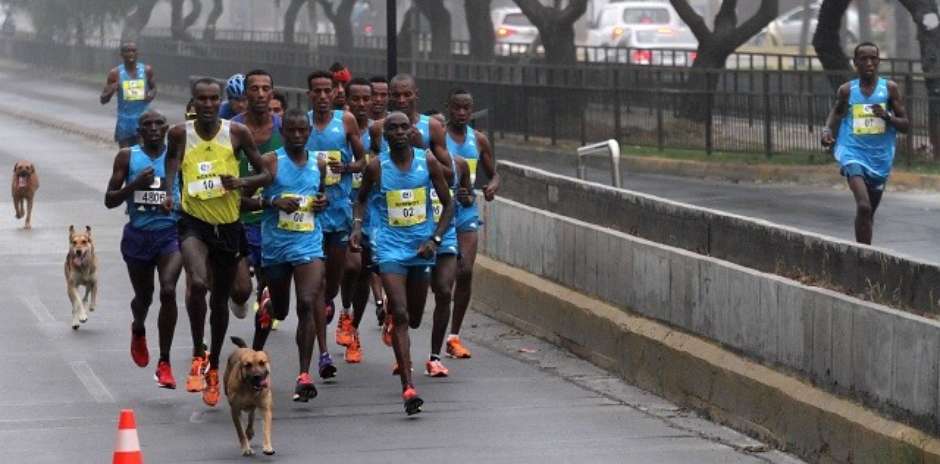 |
| From the other year, "the dogs steal the show" says the news headline. |
Early Sunday morning, dogs were rounded up and treated to food, water, shelter, toys, and love during the race. An adoption campaign looked for permanent homes throughout the day, and some number were spayed/neutered. The outcome, I actually don't know. But the awareness and good intentions, and a bit of creativity, were there.

4. Riding a metro, sweaty and with a medal.
On a normal day, I avoid riding public transportation when I'm sweaty and/or trains and buses are crowded. Marathon Sunday breaks the norm. The subway fills with runners going to and from the race, with race numbers visible early in the morning, and medals proudly displayed a few hours later. The city agreed to open the subway 1 hour early on race day, still not quite early enough for the 42k start, but a valued gesture for the 21k and 10k runners. I remember from previous years as runners piled in at each stop, filling the car with the race-day shirts and plenty of pre-race nerves.
Following our once per year, extended morning tour of downtown Santiago, I caught the metro home. Now the runners filtered out at each stop. When we reached my metro station towards the end of the line, the city and the metro were pretty much back to the state of a normal Sunday-afternoon.


No comments:
Post a Comment